00 Press Kit
Uptime Press Kit
Everything you need to cover Uptime: A Cloud Provider Sim: fact sheet, description, screenshots, logos, and a one-click asset bundle. Questions, keys, interviews: press@playuptime.com.
01 Fact sheet
The essentials.
- Developer / Publisher
- RubyRack Games
- Platforms
- Windows · macOS · Linux
- Genre
- First-person management / tycoon / simulation
- Demo
- Free on Steam, 6 July 2026
- Early Access
- 17 July 2026
- Price
- Announced at launch
- Engine
- Deterministic Rust, headless and replay-stable
- Website
- playuptime.com
- Press contact
- press@playuptime.com
- Social
- @uptimegame · Discord
02 About the game
You don't manage a datacenter from a spreadsheet. You walk it.
Build a cloud provider from a garage to a hyperscaler, and the networking is really simulated.
Uptime is a first-person cloud-provider sim. You buy the hardware, carry it to the rack, and run every cable by hand, then keep real customers online as a deterministic engine pushes back. Under the tycoon layer the infrastructure is modelled for real: L2/L3 switching, RSTP (loop it and the floor drowns in a broadcast storm), LAG, oversubscription, fault domains, power budgets, mTBF.
A one-key jargon mode flips the whole UI between plain language and real terminology, so newcomers can finish it and engineers can turn the training wheels off. Two Point Hospital meets Factorio, in a modern datacenter.
What makes it different: most datacenter games model the network as one bar that fills up. Uptime doesn't fake it. Every port, cable, switch and host is a live entity, and every LED reads real state. Working SREs respect the sim; non-engineers can still finish the campaign.
- First-person, hands-on Walk the floor, carry the hardware, run the cable.
- Cabling as a hero mechanic Typed connectors, enforced reach and bend radius, live edges that carry traffic.
- Customers as commitments Reputation earned slowly, lost in an instant.
- A real cloud to run VMs, storage, databases, Kubernetes, load balancers, each with a control plane and per-host agents.
- A simulation that pushes back Spanning tree, LAG, oversubscription, fault domains, BGP-style reachability.
- Readable for anyone, honest for pros A one-key jargon toggle over the same underlying systems.
03 For the engineers
You already know whether we mean it.
Here's what's under the hood. Ignore the depth and still win — or turn the training wheels off and lean all the way in.
Built on a deterministic Rust engine. The renderer only ever shows you what the engine already decided — nothing is faked for the camera.
- Typed ports and cables; real LAG / link-aggregation with member links
- Managed L2 and L3 switches — a real switching fabric, not one abstract "network" stat
- RSTP that converges, elects a root bridge, and blocks redundant ports
- Oversubscription that bites when you cheap out on uplinks
- Fault domains and single-points-of-failure that are computed, not cosmetic
- Reachability chains: host → switch → demarc → uplink, gating every allocation
- Services split into a control plane and per-host data-plane agents
- Power draw and wear modelling; hardware ages, no random death timer
- Capacity as workload shapes fitting host shapes — not a scalar bar
- Reputation as an asymmetric ledger, with a capacity-fit check before you sign
- Deterministic engine: same seed, same run — headless-testable, replay-stable
04 Media
From a garage to a hyperscaler.
05 Logos, key art & downloads
Grab what you need.
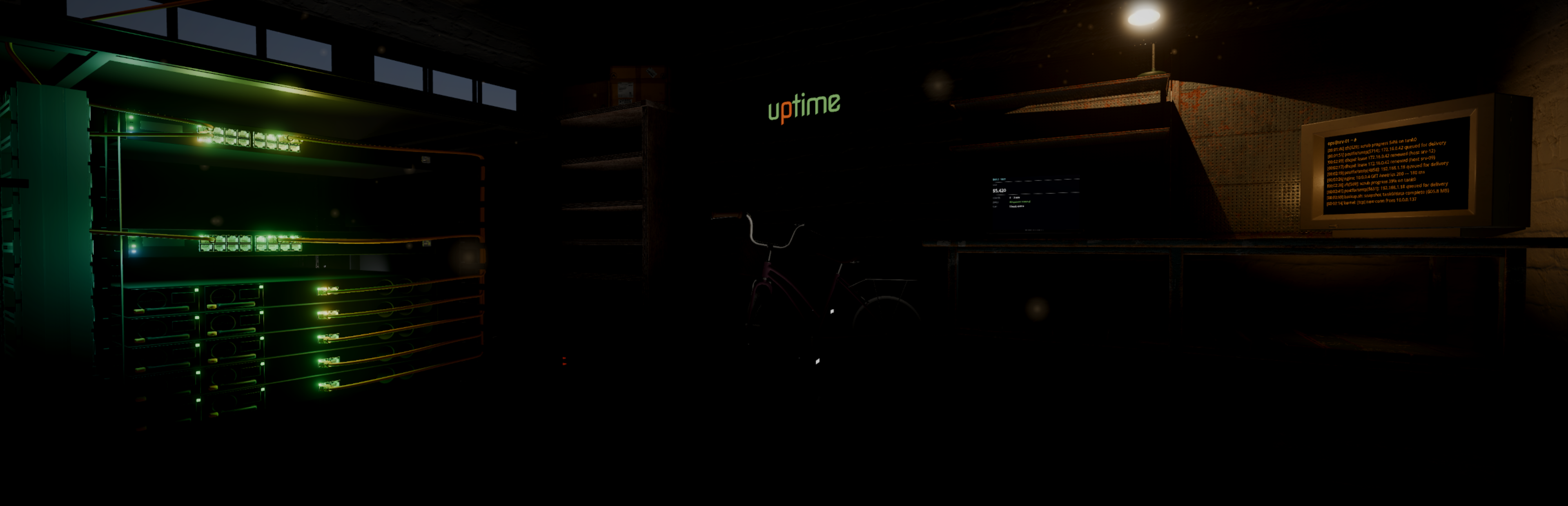
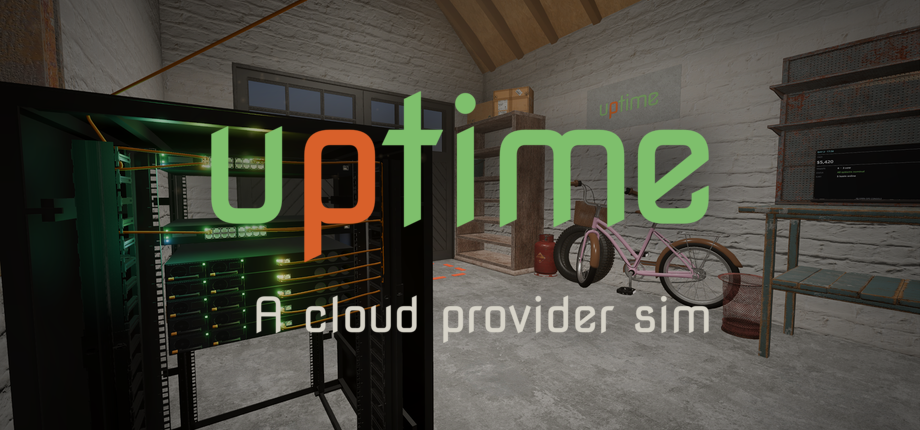
The bundle has logos, key art, all nine screenshots and the fact sheet. Screenshots are also viewable above.

06 Contact
Talk to us.
Demo keys are available now; Early Access review keys on request. Happy to answer anything, or set up an interview or dev Q&A.
© 2026 RubyRack Games. Press are welcome to use any text and media here, including monetised video and streams.