You don't manage a datacenter from a spreadsheet. You walk it.
A first-person infrastructure sim where ports, power, fault domains, RSTP and BGP do
real work, not flavour text. Readable for newcomers, honest for engineers.
Early Access out now
Uptime is in Early Access on Steam, Windows, macOS and Linux. The free demo is still
available if you want to try the first hour first.
Get it on Steam.
WindowsmacOSLinux
spool · port · live
01 Hands on the hardware
You build it with your hands.
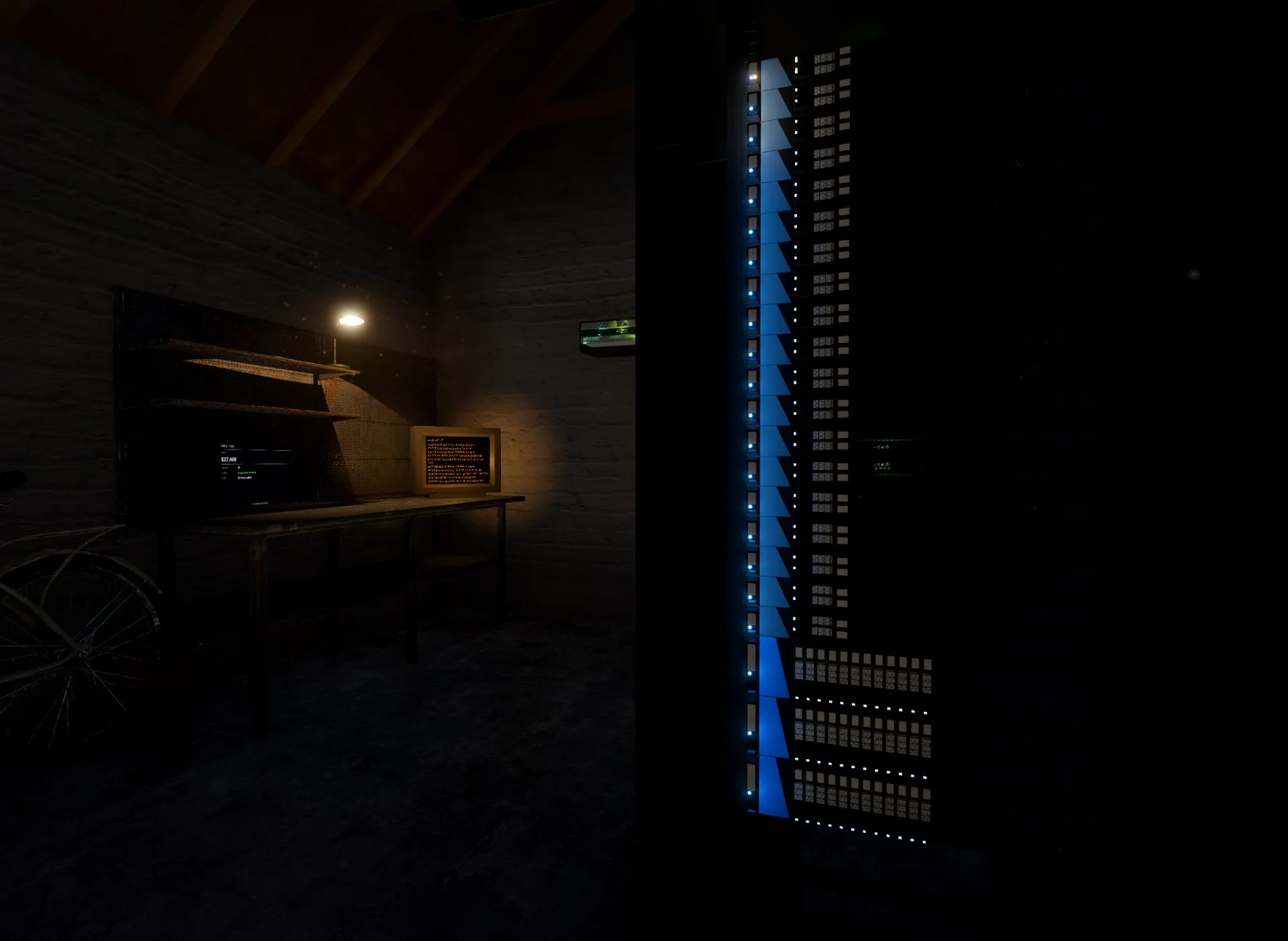
Uptime drops you onto the floor of your own cloud provider, first person. Buy the servers,
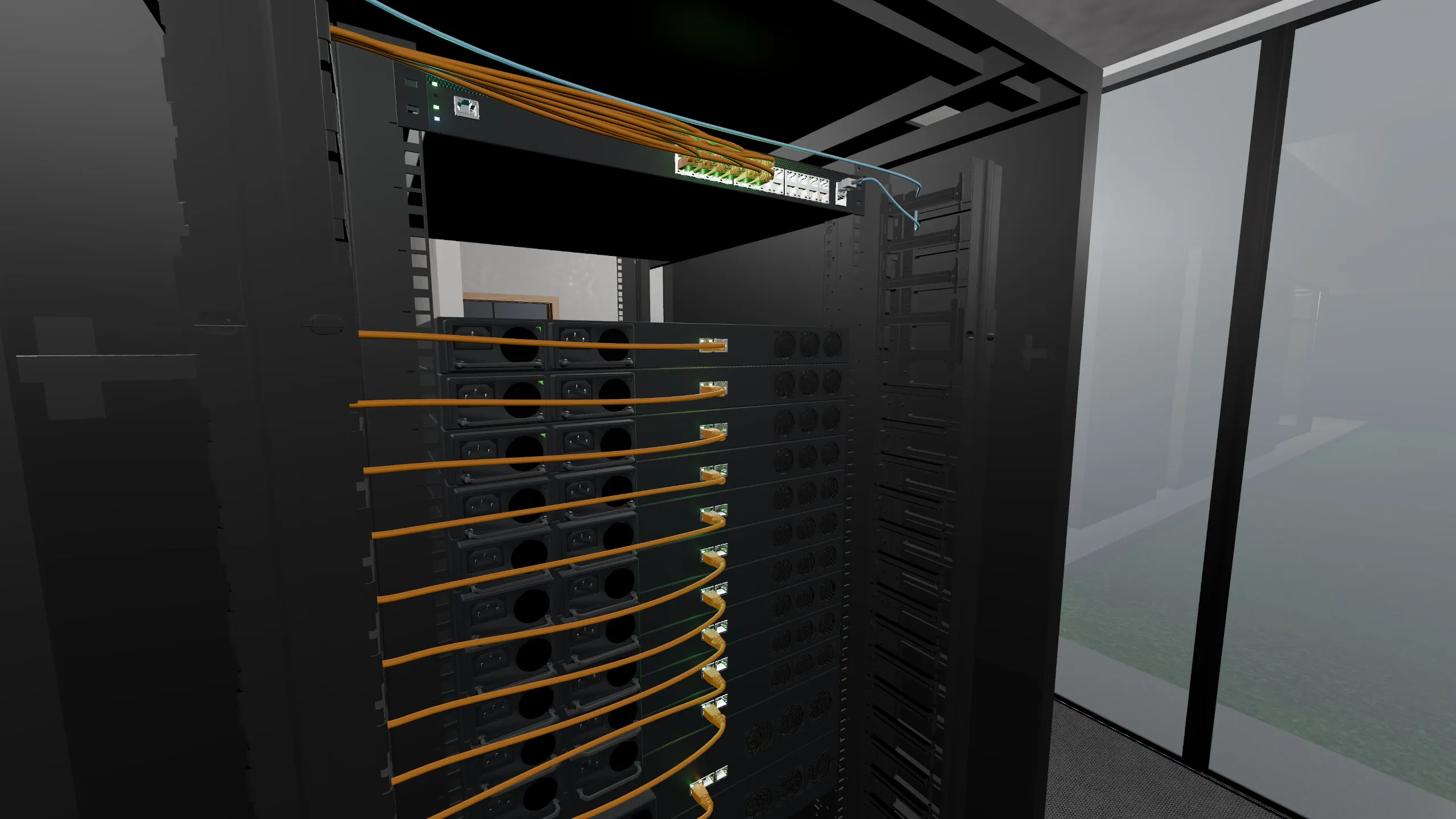
carry them to the rack, seat them with a satisfying click. Run the cable yourself: pull it
off the spool, find the port, watch it lay across the floor with real sag. Power on. Sign
your first customer.
Underneath all of it is a real simulation. Every server, switch, cable and port is a live
entity in a deterministic engine, not set dressing, not a bar filling up. When something
breaks, it breaks because the model says it should.
02 What makes it Uptime
You're not running a server room. You're running the cloud.
You own the whole stack: the metal, the network, the services you sell, and the customers
who bet their product on staying up.
001
Customers as commitments
These aren't income tickers. They're named tenants who bet their product on staying up. Reputation is the currency: slow to earn, gone in a moment when you break a promise, and the bigger the customer the harder the fall.
002
A real cloud to run
Your customers spin up VMs, object storage, managed databases, Kubernetes and load balancers, each one infrastructure you actually operate, with a control plane to keep alive and agents on every host competing for real compute.
003
A simulation that pushes back
Ports, power, fault domains, oversubscription, spanning tree, BGP and MTBF are the model, not labels on a progress bar. Cable a redundant link wrong and either spanning tree saves you, or the floor drowns in a broadcast storm.
004
Readable for anyone, honest for the pros
Diegetic mentors walk newcomers in, and one key toggles jargon mode: the whole interface flips between plain language and the real terminology, on the same underlying systems. Learn the real words by playing.
The simulation is real
When a rack goes dark, it's because a fault domain you didn't think
about turned out to be a single point of failure.
03 For the engineers
You already know whether we mean it.
Here's what's under the hood. Ignore the depth and still win — or turn the training wheels off
and lean all the way in.
Built on a deterministic Rust engine. The renderer only ever shows
you what the engine already decided — nothing is faked for the camera.
uptime · engine.specVERIFIED
OKTyped ports and cables; real LAG / link-aggregation with member links
OKManaged L2 and L3 switches — a real switching fabric, not one abstract "network" stat
OKRSTP that converges, elects a root bridge, and blocks redundant ports
OKOversubscription that bites when you cheap out on uplinks
OKFault domains and single-points-of-failure that are computed, not cosmetic
Uptime is in Early Access on Steam now, Windows, macOS and Linux. Build a cloud provider
from a garage up, and help shape where it goes next. New to it? The free demo still lets you
try the first hour before you buy.